CONNECTIVITY
LoRaWAN vs NB-IoT vs LTE-M: choosing an LPWAN
All three move a handful of bytes a day off a battery, over kilometres. They differ on who owns the network, what happens when the device moves, and how long the airtime rules make you wait between messages.
Two spectrum regimes, three specifications
LoRaWAN is a specification from the LoRa Alliance that runs on top of LoRa, a chirp spread spectrum physical layer that is Semtech's own intellectual property. The MAC layer and regional parameters are open documents anyone can implement, while the radio silicon comes from Semtech or licensees of its cores. It operates in unlicensed sub-GHz spectrum, 863 to 870 MHz in Europe and 902 to 928 MHz in the United States.
NB-IoT and LTE-M are 3GPP standards in licensed cellular spectrum. Both arrived in Release 13 as new device categories, Cat-NB1 for NB-IoT and Cat-M1 for LTE-M, with Cat-NB2 and Cat-M2 following in Release 14. The GSMA treats them as complementary rather than competing, because most large operator groups run both.
The structural consequence gets underrated. A LoRaWAN network can be entirely yours: buy gateways, run ChirpStack or the open source build of The Things Stack on your own hardware, and nobody sits between you and your sensors. Licensed spectrum rules that out for the cellular pair.
The radio numbers, and where they come from
LoRaWAN buys range by slowing down. Semtech's SX1261/2 datasheet gives typical receiver sensitivity of -124 dBm at spreading factor 7 with 125 kHz bandwidth and -137 dBm at SF12, both in boosted receive gain with split RF paths and switch insertion loss excluded. Against the SX1262's +22 dBm maximum output that comes to a 159 dB link budget at SF12, which is arithmetic on two datasheet rows rather than a number Semtech publishes.
The 13 dB gained between SF7 and SF12 is paid for in airtime. Symbol rate is bandwidth divided by two to the power of the spreading factor, so one symbol at SF7 and 125 kHz lasts 1.024 ms and the same symbol at SF12 lasts 32.768 ms. Identical packet, thirty-two times as long on the air. The datasheet cross-checks this in passing, recommending low data rate optimisation once symbol time reaches 16.38 ms, which is exactly SF11 at 125 kHz. RP002-1.0.3, the LoRa Alliance regional parameters, records the same effect as indicative bit rates.
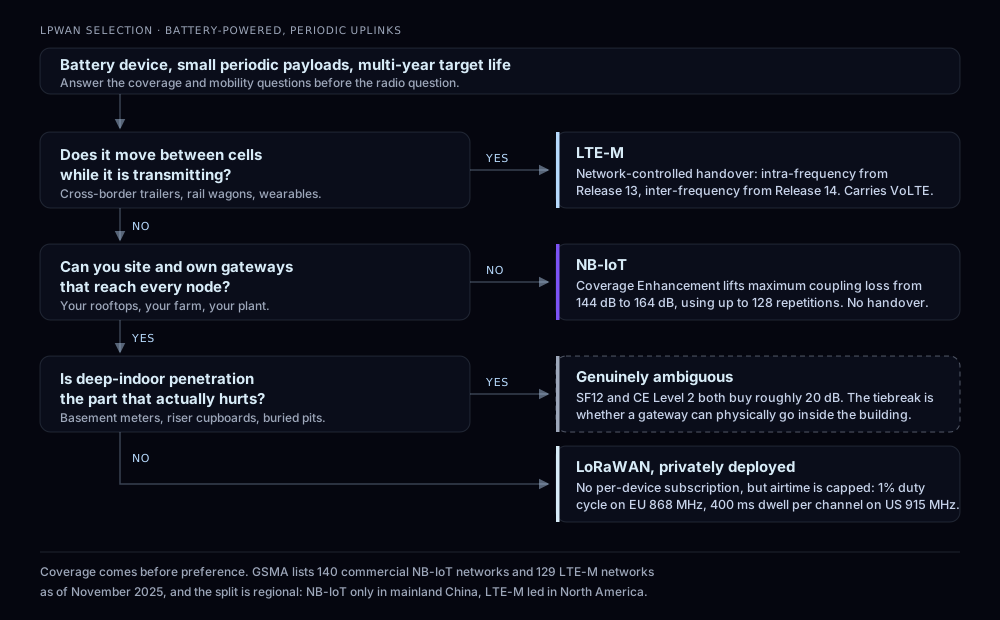
NB-IoT occupies 180 kHz, exactly one LTE resource block, and extends coverage by repetition rather than by power. The GSMA describes three Coverage Enhancement levels lifting maximum coupling loss from 144 dB, the legacy GPRS reference, to as much as 164 dB at CE Level 2 with up to 128 repetitions. The same document notes that CE levels 1 and 2 also apply a higher power density instead of power control, which raises device consumption. Deep coverage is never free.
LTE-M is the wide one, with a 1.4 MHz base channel. Release 14's Cat-M2 pushes that to 5 MHz at roughly 4 Mbit/s down and 7 Mbit/s up for full-duplex FDD devices, but the GSMA files Cat-M2 under features that have not seen wide adoption, so treat it as headroom, not a design target.
Airtime rules shape the firmware
In Europe, ETSI EN 300 220-2 lists 868.0 to 868.6 MHz at 25 mW e.r.p. with a 1% duty cycle or polite spectrum access, and 869.4 to 869.65 MHz at 500 mW e.r.p. with 10%. The standard permits listen-before-talk as the alternative, but RP002 states that LoRaWAN uses duty-cycle limited transmission exclusively to comply. A one-second SF12 uplink therefore buys 99 seconds of enforced silence on that sub-band. That constraint, not the data rate, caps how often a device can report.
The United States has no duty cycle on 902 to 928 MHz. It has dwell time. 47 CFR 15.247 requires a frequency hopping system with a hopping channel narrower than 250 kHz to use at least 50 hopping frequencies, averaging no more than 0.4 seconds on any one in a 20 second period. The two documents disagree here: RP002 paraphrases the rule as a 400 ms dwell limit "when the 20dB modulation bandwidth is less than 500 kHz", but in the CFR 250 kHz is the threshold for the 50-channel regime and 500 kHz is the maximum permitted channel width. Test against the CFR.
Mobility, and why it settles asset tracking
Only LTE-M does handover properly. The GSMA recommends intra-frequency handover, available since Release 13, and inter-frequency handover from Release 14, for all data traffic. Voice over LTE-M is possible but rare, and the GSMA observes that most carriers worldwide are opting out of deploying it.
NB-IoT has no equivalent. Release 14 introduced something labelled connected mode mobility, but the detail is RRC connection re-establishment after radio link failure, not a network-triggered move between cells mid-session, and the GSMA's own remark is that it is yet to see wide adoption. In normal operation an NB-IoT device relies on idle-mode cell reselection.
LoRaWAN avoids the question by never having a connection to hand over. An uplink is heard by whichever gateways are in range and the network server discards duplicates. A tracker moving inside your own gateway footprint works well; one crossing into somebody else's network does not, because no roaming construct resembles a cellular agreement. One asymmetry catches teams out late: both cellular standards can carry SMS, but the GSMA notes many operators enabled it for LTE-M and left it disabled for NB-IoT.
Power, quoted with its conditions
The ten-year battery figure everyone repeats traces to 3GPP TR 45.820, which set the goal as ten years on a 5 Wh battery even where 20 dB of coverage extension over legacy GPRS is needed. Its results tables are more useful than that headline. For the NB-CIoT candidate with an integrated power amplifier and transmit power capped at +23 dBm, 50-byte reports once a day give 36.0 years at 144 dB coupling loss, 31.6 years at 154 dB and 17.5 years at 164 dB. Switch to 200-byte reports every two hours and the same columns read 18.2, 5.9 and 1.5 years. The report states it plainly: at 154 dB with a 200 byte payload, or at 164 dB with either payload, a 10 year battery life is not achievable for a two hour reporting interval.
The LoRaWAN side carries a matching lesson. "Energy Consumption Analysis of LPWAN Technologies and Lifetime Estimation for IoT Application", in Sensors in 2020, measured a Murata ABZ-078 module at 3.7 V sending 5-byte uplinks at SF9, recorded 39.73 mJ per transmission, and projected 9.9 years on a 10,000 mAh cell at one message every five minutes. The same authors then report a field device flattening a 15,000 mAh battery after 60,480 messages in roughly seven months, because it idled at 6 mA rather than the 80 µA the model assumed. Sleep current decided that, not the radio.
What 2026 actually looks like
The GSMA's commercial launch tracker lists 129 LTE-M networks and 140 NB-IoT networks, 269 in total, last updated November 2025. It no longer publishes a country count, so a "networks in N countries" figure quoted today is stale. The distribution is regional: mainland China's three operators run NB-IoT and no LTE-M, every North American entry on the list includes LTE-M, and the large European groups mostly run both.
Legacy shutdowns are pushing devices onto these bearers, though the shape of that pressure is local. T-Mobile US retired its 3G UMTS network on 1 July 2022 and its 2G GSM network on 3 August 2026, four years later. Germany's regulator records 3G switched off in 2021 while the operators' 2G networks run to 2028, with Vodafone continuing to the end of 2030 in exceptional cases of critical IoT applications. Switzerland went the other way, 2G already off while 3G ran to the end of 2025. So the claim that 2G outlived 3G to protect metering is true in Germany and false in Switzerland.
On roaming, be careful with the folklore. The GSMA's February 2026 deployment guide does not claim either technology roams more widely. It records different minimum baselines: LTE-M roaming starts from IP over the user plane, NB-IoT from IP over the control plane with the control plane CIoT optimisation, and each is poorly supported on the other's preferred path. It also flags that NB-IoT is deployed standalone, in guard band and in band, and a roaming device has to attach whichever mode it lands on.
Cost, per device against per site
The two cost curves point in opposite directions. A LoRaWAN end-node module such as RAKwireless's RAK3172 lists at $5.99 on the vendor's own store, an eight-channel indoor gateway starts around $154 and an outdoor one at $382, and after that nobody bills you monthly. Cellular inverts it: no gateway to buy, but a dearer module and a subscription that never ends. Nordic's nRF9151 is $23.37 in single units at DigiKey and $15.38 on the 2,000-piece reel, and a Quectel BG95-M3 is $38.21 in ones. For airtime, 1NCE publishes a €12 one-off SIM covering ten years with 500 MB and 250 SMS, and Hologram's self-service plan is $1 per SIM per month plus $0.03 per MB. Those are list prices that volume contracts move.
Run the arithmetic per deployment, not per device. A hundred sensors on one campus repay a $154 gateway almost immediately. A hundred scattered across a county do not, because the cost there is the gateway sites and backhaul.
Which one, for what
- Dense urban metering in buildings you control. LoRaWAN, with your own gateways. The per-device saving compounds across thousands of endpoints and no subscription comes up for renegotiation in year six.
- Dense urban metering in buildings you do not control. NB-IoT. The operator already solved site acquisition, which is the expensive part.
- Remote agriculture. LoRaWAN with your own gateway and network server. Cellular coverage in a field is a question no datasheet answers, and owning the gateway makes it moot.
- Moving assets across borders. LTE-M, without much argument. It is the only one with genuine handover, and its roaming baseline is the user plane most LTE-M operators already run.
- Deep-basement sensors. Honestly ambiguous. CE Level 2 and SF12 both buy roughly 20 dB and both charge for it in battery life. Decide on whether a gateway can physically go in the building, not on link budget.
The most common case is the least decisive: a fixed sensor, a few hundred bytes a day, in a market running both cellular options. Either works. Lean to LTE-M if firmware updates over the air or SMS triggers matter, to NB-IoT if the device sits somewhere with poor signal and you want CE Level 2 in reserve. For short-range or mains-powered devices none of these three is the right family, and the connectivity decision guide covers what is.